George is a naturalist, photographer, and experienced destination lecturer who has informed and entertained thousands with his passion for science, nature and culture... presented with a twist of wry humor.
Things are getting tricky out there!! As a I write this deadly tornadoes are battering Texas and a wide swath through central and southern USA. December tornadoes are rare for this area and can be largely attributed to the very strong El
Niño in the Pacific.
We rely on science to make decisions - but how does science really work...??
"Mapping the Blue" is an excellent film. It provides an overview of the benefits -- and challenges -- of protecting large sections of our oceans. I highly recommend watching this short film for the beautiful scenes from the Cook Islands as well as insights into how Marine Protected Areas can shift the conversation towards healthier ocean ecosystems.
By
protecting ocean ecosystems rather than focusing on individual species, Marine Protected Areas (MPAs)
are powerful tools for conserving and restoring ocean biodiversity. These
special ocean areas also provide benefits to cultural and geological resources
and can help sustain local economies. In addition, MPAs contribute to
healthier, more resilient ocean ecosystems that can better withstand a wide
range of impacts. No-take marine
reserves have been proposed as one of the most successful tools for
conservation and restoration of coastal and marine ecosystems.
In 2012 the Cook Islands announced the largest Marine Park on Earth at the time. Since then, in 2015 the USA enlarged the Pacific Remote Islands Marine National Monument to form the largest MPA on earth at 490,000 sq. miles or 3x size of California.
The magnificent Cook Islands are among the most awesome places on
the planet and local people, traditional leaders and the fishermen are determined that it should remain so.
"Mapping the Blue" tells the story of how
Rugby League star, Kevin Iro, turned conservationist and founded the
world's largest sanctuary where he used to play as a boy. By using high
tech mapping, Iro and his team are able to show the best uses for areas
within this pristine ocean park which is good for conservation and the
needs of local people.
This film is a must-see for all those
interested in the health of our oceans from marine biologists to
recreational scuba divers. It points to a model of how such precious
areas can be preserved all over the world and provides hope for the
future.
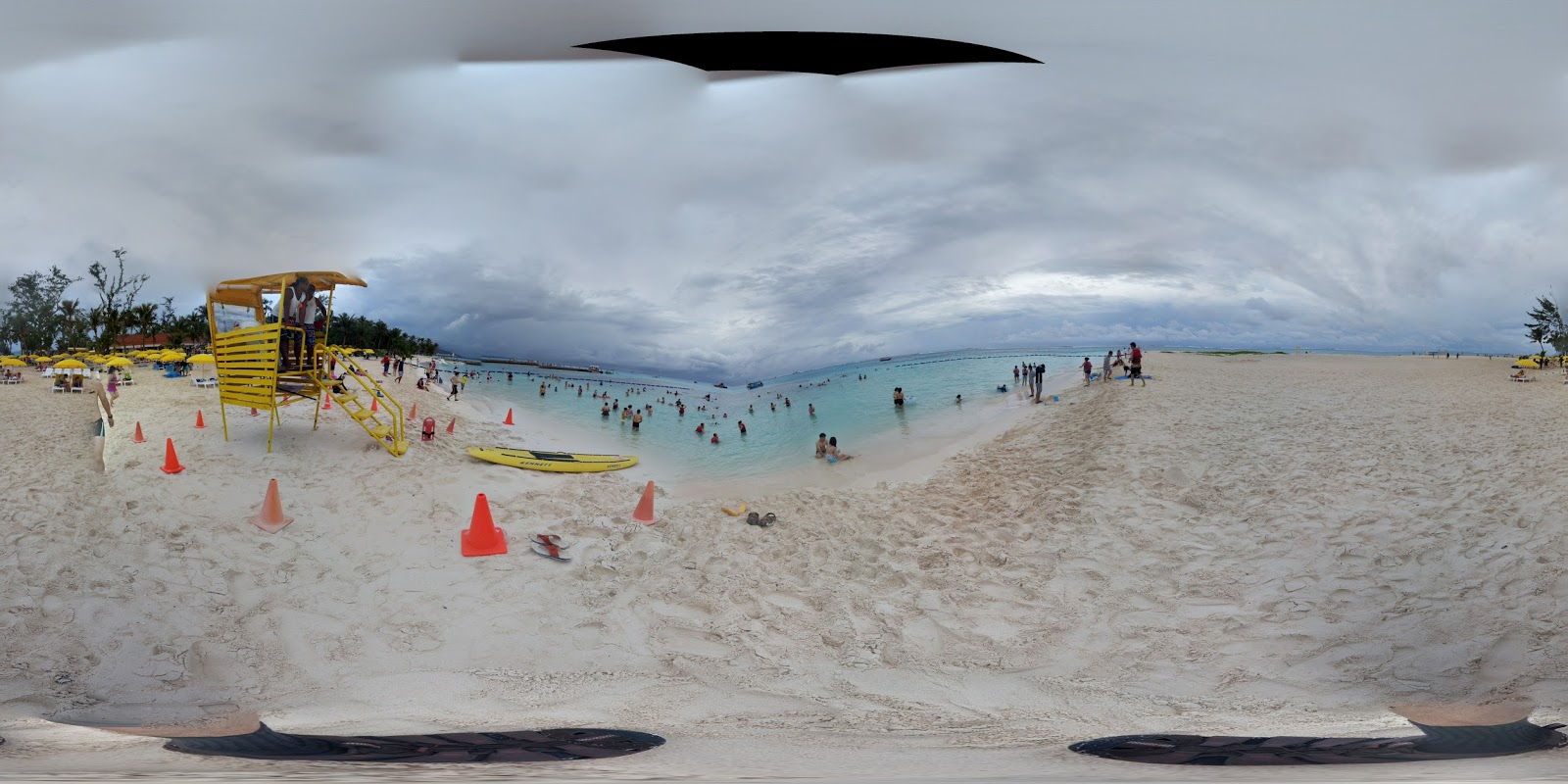
Photospheres are a new and exciting way of capturing some of your most scenic locations on a voyage. I've posted a few of my latest photospheres from the final voyage of the Statendam on Google Maps. The photo above looks strange until you go to the google maps version and open it as a photosphere. It feels like you're standing inside a bubble. This one shows the Statendam docked in Hilo on its final voyage across the Pacific. We joined the ship in Hilo and I presented a series of lectures across to Singapore.
The easiest way to create a photosphere is with an Android cell phone after downloading the Google camera app. You can also use a regular camera but it takes more work stitching all the photos together into a panorama and processing the results through another app. There's an excellent tutorial online at geojournalism.org
Taken at the entrance to Lihue harbour in Kaui, Hawaii - see https://goo.gl/maps/LbGzYr5a28R2
This was taken at Managaha beach, Islet Managaha, Saipan... it may not be accepted to Google Maps because of the missing piece of sky
Once you've taken a photosphere, you can upload it to Google Maps and it will be available for everyone to see. One of the neatest things is that you can see how many views your photosphere receives - or any photo uploaded to G Maps for that matter. One of my photospheres has had over 6,000 views in a matter of three months.
Directions for uploading photospheres are available on the Street view site. One thing I've noticed with Google -- often unfortunately! -- is that they change things frequently... by the time you read this they may have a whole new approach to all of this... at which point you might have to search for the most recent information.
Dear friends from the Statendam -- thank you so much for your kind support and amazing attendance during my lecture series, as we crossed the Pacific from Hawaii to Singapore. We had a lot of fun, didn't we!
Here are a couple of the quotes that I used during my presentations... please feel free to download copies.
I managed to capture photos of an Oriental Pied Hornbill and Java Sparrow while we were
in Kota Kinabalu, Malaysia.
Oriental Pied Hornbill
Java Sparrow
Can you believe we were wandering the wilds of Borneo
just a few days ago! (Ok -- perhaps we weren't exactly in the wilds,
but we did manage to hang onto our heads, so that makes for a good
story!)
Happy travels wherever you may be in the world. Please sign up for email updates over on the right.
Thanks again!
George
PS: my next post will be on some of the Photospheres that I captured on our voyage.