Showing posts with label global warming. Show all posts

Monday, December 28, 2015

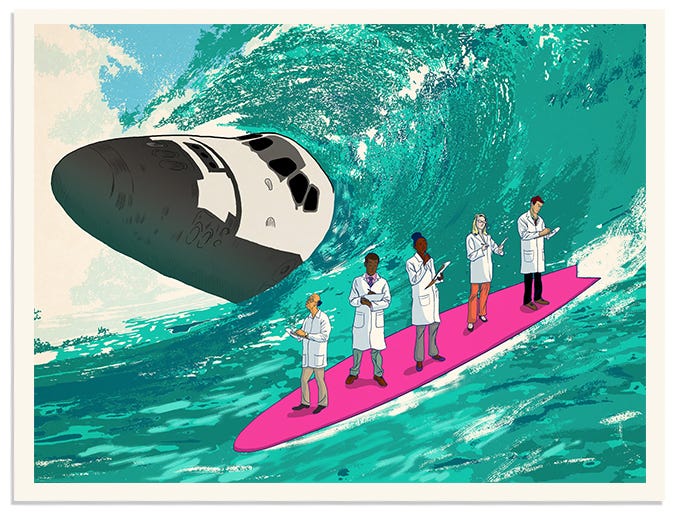
How Science Works Video

Things are getting tricky out there!!  As a I write this deadly tornadoes are battering Texas and a wide swath through central and southern USA. December tornadoes are rare for this area and can be largely attributed to the very strong El NiƱo in the Pacific.


We rely on science to make decisions - but how does science really work...??

This video provides an excellent explanation.


Saturday, September 6, 2014

Travel Priorities in the face of climate change


Thirty-three things to eat, drink, see, and do before climate change ruins them. 

Part bucket list, part illustrated guide to global eventualities and painful realities, Kurt McRobert and Rich Petrucci’s rundown of the wonders threatened by climate change is at once entertaining, sobering, and a very practical way to prioritize your travel plans. (thanks to www.QZ.com for this link...)

Friday, August 22, 2014

Protecting Parrotfish Can Help Save Reefs


Excellent report and short video available on how to protect coral reefs, based on forty years of research in the Caribbean. 

Based on over 40 years of research in the Caribbean, Dr Jeremy Jackson, senior advisor on coral reefs for the International Union for the Conservation of Nature, writes:

"We already know that protecting parrotfish and other herbivores from fishing can, in turn, protect healthy reefs. The stunning Flower Garden Banks in the northern Gulf of Mexico are protected by their United States National Marine Sanctuary status, which prohibits the use of fish traps and parrotfish fishing. Bermuda has an even longer history of banning fish traps and spearfishing. And Bonaire, with an entirely tourist-based economy that is reliant on the health of their reefs, has long restricted fishing. A brief breakdown in these protections resulted in an immediate decline in the health of Bonaire’s reefs, which triggered a quick reinstatement of protections. 

But reefs where parrotfish are unprotected have suffered tragic declines. These “Failure Reefs” are places where a variety of local human impacts have been allowed to run unchecked: not just by overfishing but also by overuse for recreation, excessive and destructive coastal development, and pollution. The worst of these include Jamaica, the entire Florida Reef Tract from Miami to Key West, and the U.S. Virgin Islands."

Tuesday, May 6, 2014

Climate Change resource

In my lectures, I try to give folks some insights into the massive changes we're seeing in the oceans, such as rising seas and acidification, and weather conditions around the planet.  One excellent resource is available online at the Guardian websitethe ultimate climate change FAQ.

As far as economics are concerned, here's the conclusion of one of the most recent articles:

It's important to understand that our choices aren't to either reduce carbon emissions or to do nothing. Our options are to either reduce carbon emissions or to continue with business-as-usual emissions that will cause accelerating climate change and damage costs beyond what we can accurately estimate. From an economic perspective, and from a risk management perspective, this should be a no-brainer. As economist Paul Krugman put it,
"So is the climate threat solved? Well, it should be. The science is solid; the technology is there; the economics look far more favorable than anyone expected. All that stands in the way of saving the planet is a combination of ignorance, prejudice and vested interests. What could go wrong?"

Monday, July 8, 2013

Oceans inc Website - excellent overview of threats to Oceans


 I've run across an excellent website for gaining a "big-picture" understanding of the current state of the world's oceans. 
Oceans inc is a multi-media platform dedicated to transmitting news about the ocean. It is concerned solely with what affects the ocean and the measures necessary to preserve it for humankind.
Ocean inc covers key ocean events around the world, issuing TV and written news as well as live coverage via social media. Follow Ocean inc for major ocean events throughout the year and on Twitter via @oceans_inc

Wednesday, July 18, 2012

Half of Our Oxygen comes from the Oceans

One of the thousands of species of Diatom via Discovery.com. Diatoms are photosynthetic plankton (microscopic algae) ubiquitous in oceans and freshwater systems. They are a major source of nutrients for marine organisms as well as a major producer of oxygen.
   
Phytoplankton (photosynthetic plankton) play a huge, and largely under-appreciated, role in feeding every living creature on this planet!  And they provide half of all the oxygen we breath.  Consequently -- life on earth depends on these tiny nearly invisible organisms floating by the trillions upon trillions in the oceans around us.

Given this understanding, headlines such as the one below from Scientific American are more significant than they might first appear.

Phytoplankton Population Drops 40 Percent Since 1950

Researchers find trouble among phytoplankton, the base of the food chain, which has implications for the marine food web and the world's carbon cycle.

I highly recommend this very informative Scientific American article to put the decline in phytoplankton into perspective.

Here's a slide from one of my lectures on "Life on the Open Ocean"
 

Friday, April 27, 2012

Oyster Die-offs Show Ocean Acidification Has Arrived

The acidification of the world’s oceans from an excess of CO2 has already begun, as evidenced recently by the widespread mortality of oyster larvae in the Pacific Northwest. Scientists say this is just a harbinger of things to come if greenhouse gas emissions continue to soar. 

Elizabeth Grossman: Yale Environment 360
This graph illustrates the correlation between rising levels of carbon dioxide (CO2) in the atmosphere at the Mauna Loa observatory off Hawaii with rising CO2 levels in the ocean. As more CO2 accumulates in the ocean, the pH of the ocean decreases. (Courtesy of NOAA/Modified after R.A. Feely, Bulletin of the American Meteorological Society


Ocean acidification — which makes it difficult for shellfish, corals, sea urchins, and other creatures to form the shells or calcium-based structures they need to live — was supposed to be a problem of the future. But because of patterns of ocean circulation, Pacific Northwest shellfish are already on the front lines of these potentially devastating changes in ocean chemistry. Colder, more acidic waters are welling up from the depths of the Pacific Ocean and streaming ashore in the fjords, bays, and estuaries of Oregon, Washington, and British Columbia, exacting an environmental and economic toll on the region’s famed oysters.

Read the entire article at: 
Northwest Oyster Die-offs Show Ocean Acidification Has Arrived by Elizabeth Grossman: Yale Environment 360

Here's a link to a scientific seminar presentation providing a detailed overview of ocean acidification. Dr. Chris Sabine presents a seminar on ocean acidification as a part of the “Climate Science 101″ short course sponsored jointly by the Osher Lifelong Learning Institute (OLLI), at George Mason University, and NOAA.  This session reviews ongoing impacts of acidification on marine ecology and projections of likely future impacts on marine life if this trend continues.

Jellyfish on the rise in world's coastal ecosytems


During my lectures I enjoy talking about the fascinating lives of some of the less charismatic ocean creatures -- without backbones or brains!! (Or hearts, gills, teeth... etc!)   You know!.... those spineless wonders known as Jellyfish.  As the oceans become more acidic and warmer the jellyfish are happily proliferating


Jellyfish are increasing in the majority of the world's coastal ecosystems, according to the first global study of jellyfish abundance by University of British Columbia researchers.

In a study published in this month's edition of the journal Hydrobiologia, UBC scientists examined data for numerous species of jellyfish for 45 of the world's 66 Large Marine Ecosystems. They found increasing jellyfish populations in 62 per cent of the regions analyzed, including East Asia, the Black Sea, the Mediterranean, the Northeast U.S. Shelf, Hawaii, and Antarctica.

"There has been anecdotal evidence that jellyfish were on the rise in recent decades, but there hasn't been a global study that gathered together all the existing data until now," says Lucas Brotz, a PhD student with the Sea Around Us Project at UBC and lead author of the study.

See the article here:  Jellyfish on the rise in world's coastal ecosytems