Showing posts with label evolution. Show all posts

Sunday, September 29, 2019

Flamingo feeding in Walvis Bay, Namibia

Flamingo beaks have mystified scientists for 2,000 years.
While on a visit to Walvis Bay in Namibia, I had the opportunity to film this
Greater Flamingo dancing to stir up shrimp and larvae living in the mud. 
(OK - I admit I added the music!)

Have you ever run across a bird that is a filter feeder...!?  When I think of filter feeding I think of baleen whales, like the great Blue whale and Humpback, feeding on plankton.   Turns out that flamingos have a diet of tiny creatures like shrimp and other water creatures that live in and on the muddy bottom.  Their long legs and long neck allow them to feed in a range of depths. 

But there's much more to the story...as you can see from my video, flamingos feed upside down!  Consequently these birds have undergone a series of amazing adaptations through natural selection.
Their unusually shaped bill, held upside down, contains lamellae, plates that act like tiny filters to trap the creatures they feed upon. Using their tongues they suck water in at the front of the bill and pump it out through the sides.

The fact that they feed upside down has shaped the bill into the "weird" design that we see today.

In most birds, the upper beak is larger than the lower one.  So guess what happens when these birds make a living by feeding upside down?  The beaks get reversed and the lower one becomes larger.  Not only that, but the articulation of the beak to the skull has evolved!  The upper beak can move when feeding.  Turns out flamingos keep their lower beak stationary and move the upper beak against it.

Try doing that with your upper jaw!  Say cheese!
  
Thanks for visiting!  Happy adventures!

For more about the wonders of the flamingo beak see the fascinating article on Curiosity.com.

Saturday, January 6, 2018

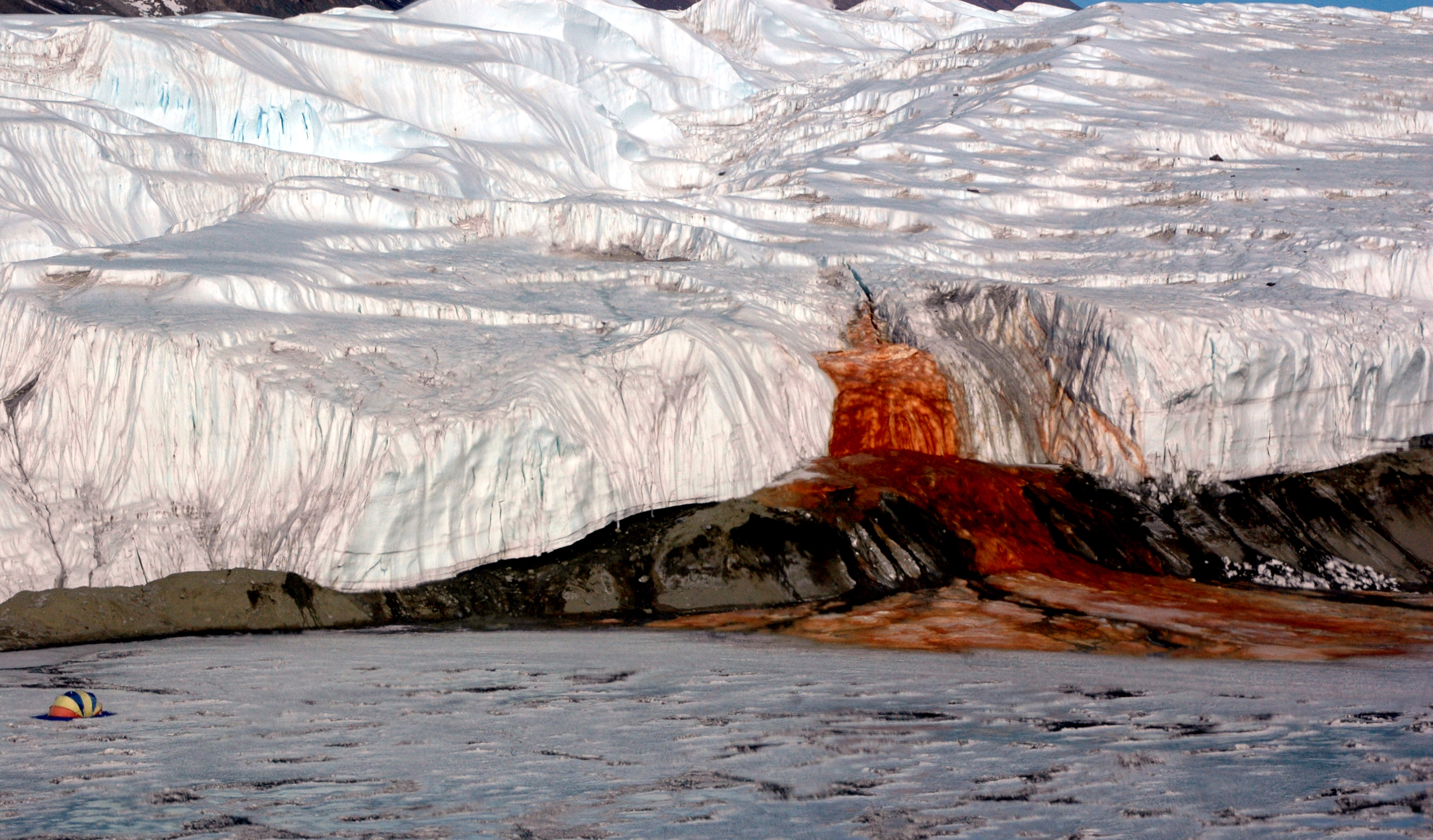
Blood Falls!! REALLY!!

It does exist... but where...???


Here's one of those stories that I just have to share.  The story of Blood Falls and the creatures that live there... it is almost beyond belief.  Microbes that "breath" iron and metabolize sulfates... an ecosystem we've never observed anywhere else on earth.

Blood Falls!!  Found at the foot of the Taylor Glacier in Antarctica.
77°43'14.5"S 162°15'28.9"E
-77.720683, 162.258037

 Check out the location on Google Maps

Here's a short excerpt from the Wikipedia entry:

Blood Falls is an outflow of an iron oxide-tainted plume of saltwater, flowing from the tongue of Taylor Glacier onto the ice-covered surface of West Lake Bonney in the Taylor Valley of the McMurdo Dry Valleys in Victoria Land, East Antarctica.
Iron-rich hypersaline water sporadically emerges from small fissures in the ice cascades. The saltwater source is a subglacial pool of unknown size overlain by about 400 metres (1,300 ft) of ice several kilometers from its tiny outlet at Blood Falls.
The reddish deposit was found in 1911 by the Australian geologist Griffith Taylor, who first explored the valley that bears his name.[1] The Antarctica pioneers first attributed the red color to red algae, but later it was proven to be due to iron oxides.

Chemical and microbial analyses both indicate that a rare subglacial ecosystem of autotrophic bacteria developed that metabolizes sulfate and ferric ions.[3][4] According to geomicrobiologist Jill Mikucki at the University of Tennessee, water samples from Blood Falls contained at least 17 different types of microbes, and almost no oxygen.[3] An explanation may be that the microbes use sulfate as a catalyst to respire with ferric ions and metabolize the trace levels of organic matter trapped with them. Such a metabolic process had never before been observed in nature.


Curiosity.com recently published a good article:
https://curiosity.com/topics/blood-falls-is-a-scarlet-oddity-in-an-antarctic-glacier-curiosity?utm_campaign=daily-digest&utm_source=sendgrid&utm_medium=email


Monday, July 18, 2016

Learn about Homo floresiensis - or ‘the Hobbit’

Homo floresiensis Photo credit: © National Geographic Society


I've just signed up for a fascinating free online course about 'the Hobbit' -
a 1 meter (3 ft) tall extinct species of hominin discovered on the Indonesian island of Flores.  If you've ever traveled with me on a cruise near the Indonesian islands, you may remember my lecture on the amazing creatures of the Australasian region - including the Hobbits and other early humans.  (Check out my experience with  Komodo dragons).

This is a FutureLearn course - which I can highly recommend!  They are well-researched and well-presented by experts in their field, with lots of multi-media, and they are available free online.

Here's the description for this course on Homo floresiensis, presented by Bert Roberts, Director of the Centre for Archaeological Science at the University of Wollongong, Australia:
 Over the next four weeks we will embark on a quest of discovery and adventure that will take you to the forefront of modern archaeological science methods and research. We will commence our journey in a cave on the Indonesian island of Flores to discover the skeletal remains of Homo floresiensis - or ‘the Hobbit’- as it has come to be known. Each week we will then follow a dedicated team of scientists to uncover clues and answer questions that expose the complexities of human evolution and the significance of archaeology.

    By the end of the course you will have a greater understanding about the discovery and international significance of Homo floresiensis, and the controversy and heated debate over its biological status. You will have examined evidence related to the stratigraphy of archaeological sites, faunal remains and stone artefacts. And you will have explored the role and application of a range of dating methods and approaches used to shed light on the life and times of Homo floresiensis, and our own origins.

        Prepare to embark on an adventure filled with mystery, questions and secrets all waiting to be unearthed throughout this quest…

Tuesday, May 24, 2016

Maasdam - Panama Canal cruisers - Thank You!!

Gatun Locks, Panama Canal from on board Maasdam, May 2016


Dear Friends from the Maasdam,

Thank you very much for being such a great audience!  Hopefully you've had a chance to regale your family and friends with tales of vineyards moving north, the Red Devils of the Sea of Cortez, and cooperative hunters communicating with the whites of their eyes!!

I presented some fascinating research on Human cooperation
(what's wrong with this picture...??)
PS: real apes don't have such highly visible white in their eyes
 In our species the sclera is bright white and the iris is colored, providing sharp visual contrast. When we look at someone, we can clearly see where their eyes are pointing independently of where their face is pointing, even at a considerable distance, thanks to the contrast between the sclera and iris.  Our eyes have evolved to enhance communication and cooperation - i.e., teamwork while hunting.  Other primate species try to keep their eye direction less discernible because they're not as interested in sharing. (see Nature 387, 767-768 (19 June 1997) Unique morphology of the human eye, Hiromi Kobayashi & Shiro Kohshima).  For more on this I highly recommend the book: Evolution for Everyone by David S. Smith.

And now, for your added enjoyment...!! Here's the clip I took of the Black-mandibled Toucan while we were on a shore excursion in Puntarenas, Costa Rica, feeding on the Cecropia tree.


Thanks again for a great voyage... hope to see you on another cruise!!  Our next cruise will be on the Rotterdam, Atlantic Adventurer, October 25 - November 19, NYC to Athens.

If you'd like to stay in touch, please sign up for my email updates -- scroll to the very bottom and you'll find the sign-up on the right side of screen.

All the best and happy travels!!
George & Jan

Monday, December 28, 2015

How Science Works Video

Things are getting tricky out there!!  As a I write this deadly tornadoes are battering Texas and a wide swath through central and southern USA. December tornadoes are rare for this area and can be largely attributed to the very strong El Niño in the Pacific.


We rely on science to make decisions - but how does science really work...??

This video provides an excellent explanation.


Friday, July 24, 2015

Amazing Birds of Paradise: Lessons in Evolution

This video shows some birds that simply don't look real!!  Highly recommended!  It also illustrates the paradoxical nature of being male... sometimes you have to be pretty outlandish to land a female.  But what about attracting predators...?  Where's the evolutionary advantage...?  Outlandish males are the 'fittest' and get to pass on their genes.  Moral of the story: males are expendable!!  So what if a few get eaten... there are always plenty more where they came from!

The Birds-of-Paradise Project reveals the astounding beauty of 39 of the most exquisitely specialized animals on earth. After 8 years and 18 expeditions to New Guinea, Australia, and nearby islands, Cornell Lab scientist Ed Scholes and National Geographic photojournalist Tim Laman succeeded in capturing images of all 39 species in the bird-of-paradise family for the first time ever. This trailer gives a sense of their monumental undertaking and the spectacular footage that resulted. Filmed by Tim Laman, Ed Scholes, and Eric Liner.