George is a naturalist, photographer, and experienced destination lecturer who has informed and entertained thousands with his passion for science, nature and culture... presented with a twist of wry humor.
Here's one of those stories that I just have to share. The story of Blood Falls and the creatures that live there... it is almost beyond belief. Microbes that "breath" iron and metabolize sulfates... an ecosystem we've never observed anywhere else on earth.
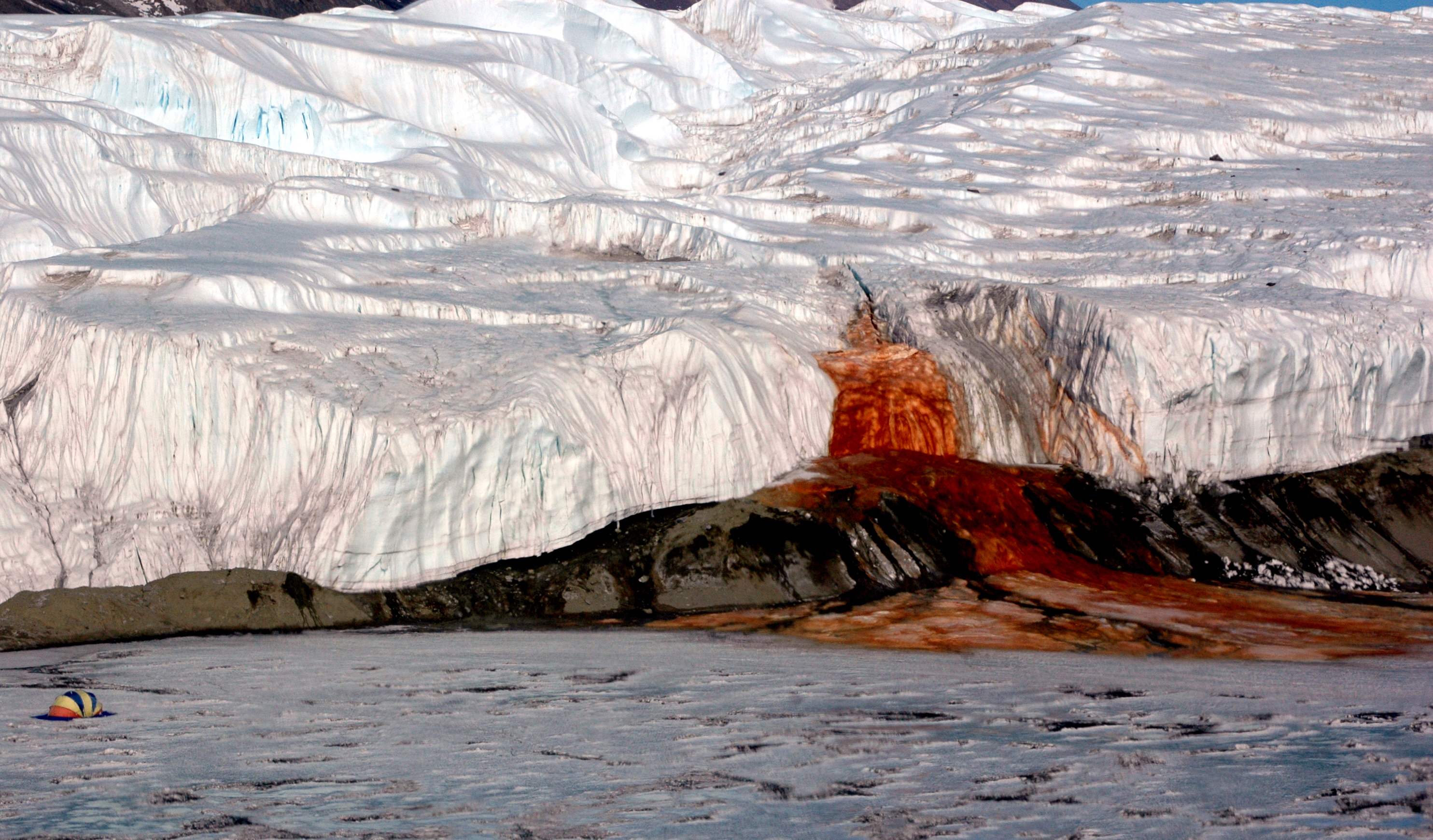
Blood Falls!! Found at the foot of the Taylor Glacier in Antarctica.
Blood Falls is an outflow of an iron oxide-tainted plume of saltwater, flowing from the tongue of Taylor Glacier onto the ice-covered surface of West Lake Bonney in the Taylor Valley of the McMurdo Dry Valleys in Victoria Land, East Antarctica.
Iron-rich hypersaline water sporadically emerges from small fissures
in the ice cascades. The saltwater source is a subglacial pool of
unknown size overlain by about 400 metres (1,300 ft) of ice several
kilometers from its tiny outlet at Blood Falls.
The reddish deposit was found in 1911 by the Australian geologist Griffith Taylor, who first explored the valley that bears his name.[1] The Antarctica pioneers first attributed the red color to red algae, but later it was proven to be due to iron oxides.
Chemical and microbial analyses both indicate that a rare subglacial ecosystem of autotrophicbacteria developed that metabolizes sulfate and ferric ions.[3][4] According to geomicrobiologistJill Mikucki at the University of Tennessee, water samples from Blood Falls contained at least 17 different types of microbes, and almost no oxygen.[3] An explanation may be that the microbes use sulfate as a catalyst to respire with ferric ions and metabolize the trace levels of organic matter trapped with them. Such a metabolic process had never before been observed in nature.
The St Kitts Scenic Railway was one of the highlights of our recent
Caribbean cruise on board the Seabourn Odyssey.
We found St Kitts to be a strikingly green and scenic volcanic island.
At the turn of the 18th century, St. Kitts was the richest British
colony, per capita, in the Caribbean, a result of the sugar trade. St. Kitts and Nevis achieved independence in 1983, becoming the newest sovereign state in the Americas.
Originally the “sugar train” was used to transport sugar cane from the fields to the central sugar factory near Basseterre. The last train was the shut down in 2005, bringing an end to
over 350 years of sugar production on the island.
We were pleased to learn that the “Sugar
Train” survives as a partnership between Government and private
enterprise, with tourist excursions beginning in 2003. This is a great way to see the island -- on the “Last Railway in the West Indies” - a living link to
a past when sugar ruled the island's economy.
Thank you to the many guests who attended my lectures and also viewed them on the entertainment channel. It was wonderful to meet you; Jan and I had a truly enjoyable adventure cruising with you through the Caribbean islands! Please do keep in touch - you can sign up for my posts in the sidebar.
Here are a couple of 360' panoramas taken while we were in port in Basse-Terre, Guadalupe. I love these 360's!! You can use your mouse to move the image all around as if you were standing there! Please feel free to share them with friends and family. You can direct people to this post on my blog or you can share them via Google Maps. I will post some more in the next day or so.